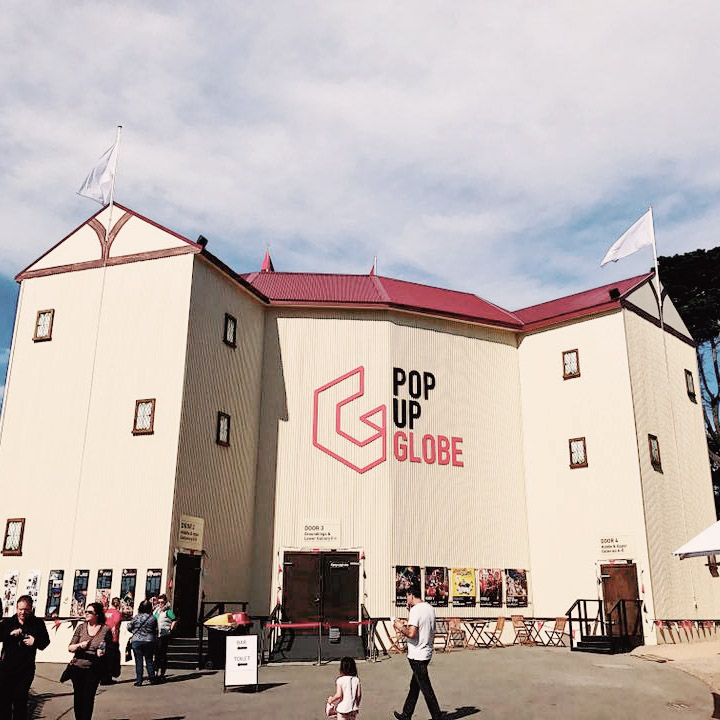
Many of you would have seen the press release (which is still up on the NZ Herald, but has been heavily altered on social media) for the next Auckland season of plays at the Pop Up Globe. It cited abuse of power, the #metoo/#timesup movement, and a “post-Weinstein world” as inspiration for the plays being staged this season. In an interview on the NZ iteration of The Project, Miles Gregory (the artistic director and founder of the Pop Up Globe) said that his goal was to present a feminist telling of the deeply sexist play The Taming of the Shrew with his – wait for it – all male cast. Now naturally there has been a lot of uproar over this. But it isn’t a new thing. There has always been discussions and controversy over the Pop Up Globe, particularly in regards to the all male companies. This week that controversy reached a crescendo with multiple articles, twitter threads, and Facebook comments from deeply upset patrons of the Globe. Anyone who has been following me on social media in recent months will know how much I’ve loved and appreciated this company. This week, however, I’m disappointed. And god knows this isn’t a new thing for me, either. I’ve debated acknowledging Miles and some of his questionable choices for months. I usually keep theatre criticism to myself and my inner circles, for many reasons, but in this case I feel that I cannot sit idly by as this drama unfolds. One thing I do agree with Miles on is that most excellent art is art that is debated and discussed. It is taken home with you and lives rent free in your mind for weeks, months, sometimes years. But excellent art is not art that makes you feel this alienated, angry, and excluded.
I’m going to put a disclaimer here before we get started. I still adore the Pop Up Globe. Shakespeare has been a part of my life ever since I picked up my first copy of Hamlet in a secondhand bookstore when I was fifteen or sixteen. It still feels like that devotion and those years of study were merely shadows in comparison to my experience at the Globe in Melbourne. It is a fundamentally wonderful, inspired idea that is bringing Shakespeare into the hearts of Australia and New Zealand in a way I never dreamed of. His works, performed in the space they were meant to be performed in, with casts of some of the most talented actors from all over the world. And yet…
One of the first articles to go online after the press release from the Pop Up Globe was from Penny Ashton. When I read it, along with many of my friends from our inner circle of Globe fans, it was like something clicked. Every single thing she said was something we had discussed, over and over again, ever since Nadia and I found out about the Globe last year. The very idea of an all male cast made me uncomfortable. The way Miles talks about it, it’s like it was an artistic decision made by Shakespeare – but here’s the thing. It wasn’t. Women performing onstage was strictly forbidden. Women doing anything outside of the “wife + baby poppin’ machine” mold was strictly forbidden. Male inventors and alchemists were praised, while women doing literally the same thing were burnt at the stake. An “artistic vision” based on such a sexist piece of theatre history is already a vision I’m not interested in. Admittedly, the Melbourne season changed my perception of this vision. There are plays in the Shakespeare canon that can work well with this idea, Henry V and As You Like It being two valid examples, but does that mean the Pop Up Globe should continue using all male casts in every season? Well, no. To quote Penny Ashton, “We are already fighting for way less roles, and so to use historical oppression as an excuse for some fun modern oppression, well that can fuck right off.”
It’s utterly wild to me that “abuse of power” is being used as well to promote this season. Sounds familiar, doesn’t it? This isn’t the first time the company, and Miles Gregory more specifically, have been taken to task over their all male casting. But they’ve ignored it. In an interview with Kate Prior, Miles was questioned about the all male casting and his responses cited the fact that they were “more commercially viable”. Perhaps we’re so used to seeing men in all the roles, almost every variation of humanity there is, that we just expect to see them onstage. Women are so used to seeing men in the biggest and best roles in fiction, that we all spontaneously burst into tears upon seeing Wonder Woman kicking some butt in cinemas.
KP: I just think it’s interesting that you’re equating commercial success with having all-male companies onstage.
MG: No I’m not suggesting that. What I said is we made work last year that sold a lot of tickets, and we have repeated that this year. There might be another question which is whether it’s valid in today’s society to make all-male work. But I am a little concerned about questions of censorship in the arts.
KP: Do you think that’s censorship?
MG: Well, I didn’t say that either. I said I am a little concerned about questions of censorship in the arts.
KP: Right.
MG: And I think that artists should be encouraged to make whatever work they want, with whoever they want, and we really shouldn’t seek to limit artists on any basis. And that means it’s okay sometimes for art to be very offensive – that’s fine, that’s actually quite good. It’s also okay for arts to be exclusive, and inclusive. Indeed art should be whatever the artist feels it should be.
(We Strive to Please: An Interview with Pop Up Globe’s Miles Gregory by Kate Prior)
Commercial viability is not a legitimate argument for keeping women off your stage. Especially when you open an (almost) all female production of Julius Caesar in response to this criticism only to give it shitty performance dates, barely promote it, and give it the shortest run of the 2017/2018 season in Auckland. I was there in February. I only managed to see opening night of Macbeth and a matinee of A Midsummer Night’s Dream; because Julius Caesar wasn’t on at all during my visit and Comedy of Errors hadn’t even opened yet, while the all male company had been onstage since December and would go on to be the only company that had an extended season. The worst part is that they can now further justify their argument that all female productions just aren’t as commercially viable as all male productions AND not take the show to Sydney with the other four plays. I heard the word “risky” thrown around a lot in reference to Julius Caesar when I was in New Zealand. I even read it in Miles’ interview with Kate Prior when the idea of all female casts was brought up. Well, I see what you’re trying to say, and I’m going to let you finish, but hearing Jacqueline Drew screaming “O god, that I were a man! I would eat his heart in the market-place” was the most iconic and validating moment of my 2017.
MG: I’m not sure what people want. Do we want to see more of a balance between the numbers of men and women who perform onstage? I’m not sure?
KP: I think it’s about industry and economics. I think it’s about women being paid. It’s about women having the opportunity to be paid in roles that were made for women.
MG: Well, that’s a very interesting aspect isn’t it. Of course none of those roles were made for women. But I’m nit-picking…
KP: Yeah, once again, we’re in New Zealand in 2017. Yes, they weren’t originally written for women but we are here, now, and they are women characters.
(We Strive to Please: An Interview with Pop Up Globe’s Miles Gregory by Kate Prior)
Another excuse for the all male casting is historical accuracy or “authenticity”. But you know what? I am so tired of historical accuracy being used as an excuse for sexism and other forms of discrimination in art. You can’t take such huge artistic and creative license with your work, but then turn around and cite “historical accuracy” when your period piece comes under fire for its blatant discrimination and sexism. Miles Gregory mentioned in his apology that the Pop Up Globe has always strived to represent the diversity of the human condition. But that’s the thing. Shakespeare has stayed relevant for all these years because his work is relevant to everyone. He wrote some of the most iconic male roles, but he also wrote some amazing and intelligent women. Regardless of gender, we can all see ourselves in his plays and his characters. Except women can’t, in certain cases, because here’s some men playing those amazing women – as if there aren’t enough opportunities onstage for them already.
The thought of women playing men’s roles is not a new one, but where men playing women is accepted the reverse is not the case. The argument goes that men are entitled to play women because they did in Shakespeare’s day. Women have to find a justification beyond “I want to show I can do it”. We are required to ask: “Why does anyone need to see me play Hamlet just because I want to?”
Hamlet is Everyman, a universal, cross-cultural figure. Women identify with him too, but we cannot play him because he is a man. Imagine you are trained and capable of playing Beethoven’s piano concertos but you are forbidden to perform them because you are a woman.
[…]
Potentially the theatre is the most progressive of the performing media. It would be great if more people decided it was justifiable to cast women in men’s parts. But historically a breakthrough by women is often recorded as a one-off exception. There is a totally uninvited pressure on this production of Julius Caesar to be the definitive all-woman Shakespeare — and, if it isn’t, we will be thought to have blown our chances. And if the show is successful we don’t want that to be an excuse for anyone to say: “Well, we’ve done an all-female production, so we don’t need to do another one.”
(Harriet Walter on playing Brutus in an all female Julius Caesar)
Diversity is a word thrown around a lot these days. But how is it “diversity” when you cannot and will not represent the voices of half the population? Women are not a minority until certain male artists decide that they should be. Christ, we’re only a minority in art and fiction because we are a minority in that industry. If the Globe wants to make good on their apology, they need to employ a much more diverse set of voices at their meetings. Perhaps then the words “feminism” and “all male cast” said in the same sentence might have garnered a response other than “yeah nah that sounds legit, miles, lets do it.” The best Midsummer Night’s Dream I ever saw was a little student production in Sydney. It had no budget to speak of and, being a student production, of course it wasn’t going to be perfect. But it had something the Pop Up Globe seems to be lacking recently. It was innovative and inclusive. I think the misconception here is that we don’t want men onstage, we only want women. This isn’t what equality in art is about. It’s about seeing a diverse range of people of all genders, races, abilities, body types, ages, and sexual orientations onstage. It’s about looking at these fictional characters and seeing yourself. “Mirror up to nature”, Miles. “Mirror up to nature.”
Some of the success in As You Like It‘s season in Melbourne, at least in my mind, was due to the feeling of seeing two men getting their happy ending with the other lovers onstage during a downright harrowing marriage equality campaign. And what I appreciated the most about Much Ado was the diversity onstage and a representation of Maori culture that wasn’t stereotypical – it was beautiful and lovingly directed by Miriama McDowell. As soon as I saw the minor controversy over the use of Te Reo by the fairies in Midsummer, I jumped to Globe’s defense. And I would do it again, because that’s the Pop Up Globe I fell in love with.
And finally… the me too movement is about women telling their stories. How could you use this movement to promote your routine silencing of women and their voices. How could you use it to promote a play where a woman is tortured into submission by a man and then use an all male cast to present it – calling it feminism?? There was a name that came to my mind when I read the announcement. Eurydice Dixon. She was a young Melbourne woman with a promising career ahead of her in comedy. On her way home from a gig, she sent a text saying “I’m almost home safe, hbu?” She was found 900 meters from her home. She had been raped and murdered. This is the kind of story behind #metoo. It is a very real thing that women experience almost every single day of their damn lives. I send texts like that to all of my friends and they send the same to me. But I still don’t feel safe. I moved out of my mum’s house to cut my half hour walk home from work to only ten minutes, but I still don’t feel safe. One day it could be me and the media will say “what was she wearing?” “why was she out at night?” “women should be practicing these very specific precautions, which they are already practicing and have been practicing since the dawn of time, but I’m going to blame their ignorance when they get raped and murdered anyway just for funzies.”
How could you invalidate our stories by using this movement – OUR movement – to promote yet another season where you still value the voices of male actors over women? Women who are already suffering in this industry. Women who I know and love who don’t even feel safe in their own workplaces, in an industry that is supposed to present the diversity of the human condition and yet refuses to respect or protect us? I love the Pop Up Globe. I adore the people involved and the stories being told in that wooden O. I’m still in contact with a handful of the cast members. A few of them will be in the Sydney season later this year (some in the all male cast) and I’m so happy for all of them. But I’m deeply upset by the company’s actions this week. It’s a feeling I’m all too familiar with, I just wasn’t aware it would ever come from a place like this.
The Pop Up Globe’s press release for season four on the NZ Herald
Miles Gregory’s apology for the press release
#notyourstoo: On the Pop Up Globe’s ‘Abuse of Power’ season by Penny Ashton
We Strive To Please: An Interview with Pop Up Globe’s Miles Gregory by Kate Prior*
Harriet Walter on playing Brutus in an all female Julius Caesar**
*Highly encourage reading this. It was a catalyst for how my interpretation of the Globe’s work shifted, particularly after it left Melbourne. It’s a very insightful look into Miles Gregory’s vision for the Pop Up Globe and, uh, let’s just say I have a whole lot of respect for Kate Prior.
**I had a quote from this article saved on my blog and stuck up on my wall at home, but I never read the full piece until I was doing research for this blog post. I had to subscribe to read the whole thing and it’s just so relevant. She wrote it in 2012 while playing Brutus in an all female Caesar at the Donmar Warehouse, but it seriously could have been written about the Pop Up Globe’s Caesar by their Brutus. Harriet also wrote a book titled Brutus and Other Heroines: Playing Shakespeare’s roles for Women, which I saw recently on Instagram and can’t wait to read once it arrives in the mail.
Edit: The Pop Up Globe has since released a second statement, confirming their commitment to present equal casting of men and women in all their future productions. 14 women and 14 men will make up the companies of the 2018/2019 Auckland season.
 Emily Reginalds